North Texas summers bring some of the most dangerous heat stretches the region sees. When the National Weather Service issues an Extreme Heat Warning for Dallas-Fort Worth, actual air temperatures can run from 100 to 106 degrees, with heat index values reaching as high as 116 degrees. During these stretches, triple-digit highs can hang on for days at a time with little to no rain in sight across the Metroplex, running well above the normal summer high of around 96 degrees for DFW.
In conditions like these, your air conditioner is not a luxury. It is keeping your family safe. Here is what Dallas-Fort Worth homeowners need to know when the heat spikes.
Why Your AC Struggles More During a Heat Wave
Most residential AC systems are designed to maintain indoor temperatures roughly 20 degrees below the outdoor temperature. Under normal summer conditions in DFW, that means maintaining a comfortable 75 to 78 degrees indoors without much difficulty. When outdoor temperatures climb to 105 or higher, that same system is being asked to do significantly more work than it was designed for.
The result is a system that runs longer, works harder, and generates more heat internally. Components that were already showing wear get pushed past their limits. Refrigerant pressure increases. Capacitors and compressors that were borderline on a normal day fail outright on a 106-degree day. This is why AC breakdowns spike during heat waves, and why getting ahead of potential problems now matters more than usual.
Signs Your AC Is Struggling in the Heat
Your Home Cannot Get Below 80 Degrees
On a 105-degree day, a system working at full capacity may only be able to maintain 82 to 85 degrees indoors. That is not necessarily a sign of a broken system. However, if your home cannot get below 80 when outdoor temperatures are in the mid-90s, or if it is consistently several degrees warmer than your thermostat setpoint in milder conditions, something is likely wrong.
The System Runs Constantly Without Shutting Off
Some continuous running is expected during extreme heat. But a system that never cycles off even during cooler parts of the day, such as early morning, may be low on refrigerant, have a dirty coil, or be undersized for your home. Continuous running without cycling also accelerates wear on the compressor.
You Hear Unusual Noises from the Outdoor Unit
Banging, clanking, grinding, or repeated clicking from the outdoor condenser are warning signs that something mechanical is wrong. In extreme heat, a failing component can go from an occasional noise to a full breakdown quickly. Do not ignore new sounds from your system during a heat wave.
The System Trips the Breaker
A system drawing excess current under heat stress may trip the circuit breaker. Resetting it once and monitoring the situation is reasonable. If it trips again, the system is telling you something is wrong. Continuing to reset a tripping breaker without addressing the underlying cause can damage the compressor or create an electrical hazard.
You See Ice on the System
Ice forming on the refrigerant lines or indoor coil during a heat wave is counterintuitive but serious. It usually means the system is low on refrigerant or has restricted airflow. A frozen coil cannot absorb heat and will cause warm air to blow from the vents even though the system is running. Turn the system off and switch the fan to “on” to thaw the coil, then call for service before restarting in cooling mode.
How to Help Your AC Keep Up During Extreme Heat
While your AC does the heavy lifting, there are steps you can take to reduce the load on the system during a heat wave and keep your home as comfortable as possible.
- Check and replace your air filter. A clogged filter restricts airflow and forces the system to work harder. During extended heat events, check the filter more frequently than usual.
- Close blinds and curtains on south and west-facing windows during the afternoon hours. Direct sunlight through glass significantly increases the cooling load in those rooms.
- Set the thermostat to “auto,” not “on.” Running the fan continuously when the system is not actively cooling pushes unconditioned air through the ducts and makes the house feel warmer.
- Avoid using heat-generating appliances during the hottest part of the day. Ovens, dryers, and dishwashers add heat to the home that your AC then has to remove.
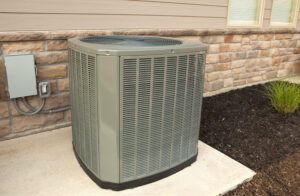
- Keep the area around your outdoor unit clear. The condenser needs to dissipate heat. Make sure there is at least two feet of clearance around it and that the fins are not clogged with grass or debris.
- Raise the thermostat setpoint slightly at night if the system is struggling. Pushing a stressed system to maintain 72 degrees in 106-degree heat causes more wear than letting it maintain 76 degrees comfortably.
How Cool Should Your House Be When It Is 100 Degrees Outside?
A standard residential AC system is sized to maintain indoor temperatures about 20 degrees below outdoor conditions. At 100 degrees outside, that means your system should be able to hold around 78 to 80 degrees indoors without running continuously. At 106 degrees, holding 80 to 85 degrees may be the realistic expectation for a system that is working correctly.
If your home is significantly warmer than that at moderate outdoor temperatures, or if you cannot reach your thermostat setpoint even in the early morning hours when outdoor temps have dropped into the 80s, the system likely has an underlying issue that needs to be addressed.
Is It Cheaper to Run Your AC All Day or Turn It Off and On?
During a heat wave, turning the AC off and then back on is almost never the right call. When a home heats up to 90 degrees or more while the system is off, it takes significantly more energy to bring it back down than it would have taken to maintain a steady temperature. The compressor also works harder during the initial pull-down period, which adds stress to an already taxed system.
A better approach during extreme heat is to raise the thermostat setpoint by a few degrees rather than turning the system off entirely. Keeping the house at 80 degrees is much easier for the system than cooling it from 95 degrees.
At What Temperature Does No AC Become a Safety Emergency?
Indoor temperatures above 90 degrees are dangerous for everyone, but particularly for older adults, young children, and people with chronic health conditions. Heat exhaustion can set in quickly and heat stroke, which is a medical emergency, can follow. The signs of heat stroke include confusion, hot and dry skin, and a rapid pulse.
If your AC fails during a heat wave and the indoor temperature is climbing toward 90 degrees or beyond, do not wait it out. Dallas County and Tarrant County open cooling centers across the Metroplex during extreme heat. Call a neighbor, go to a library or mall, and get somewhere with air conditioning while you wait for repairs. Do not leave pets in a hot home either.
Call Willard Before Your System Fails
During a heat wave, AC repair demand across the Metroplex spikes and wait times grow. The best time to call is before your system stops working, not after. If your system is showing any of the signs above, or if it simply has not been serviced in the past year and is running hard in 100-plus degree heat, scheduling a service call now puts you ahead of the rush.
Willard Cooling, Heating, Plumbing & Electrical serves Dallas, Fort Worth, Forney, and the surrounding DFW Metroplex with 24/7 emergency HVAC service. Our technicians are available around the clock during extreme heat events.
Call us at (469) 840-4743 in Dallas, (817) 290-3525 in Fort Worth, or request service online. We are available 24/7 and we will get to you as fast as possible.